
Insights
Find the latest news and insights from TrueShares below.
What are Autocallables?

Have you been hearing a lot about autocallables lately? That might be because the issuance of autocallables has seen explosive growth over the last decade, as evidenced in the rise in US autocallable sales from $78 billion in 2020 to $132 billion in 2023.1 Autocallables are one of the fastest growing asset classes right now. And it’s not hard to see why. But what are they and what do they do? Let’s dig into it.
An autocallable note is an equity market-linked investment designed to provide regular, high income and return principal at a set maturity date—or earlier—if specific market conditions are met. Its performance is tied to a reference index, such as the S&P 500.
Key Terms to Know
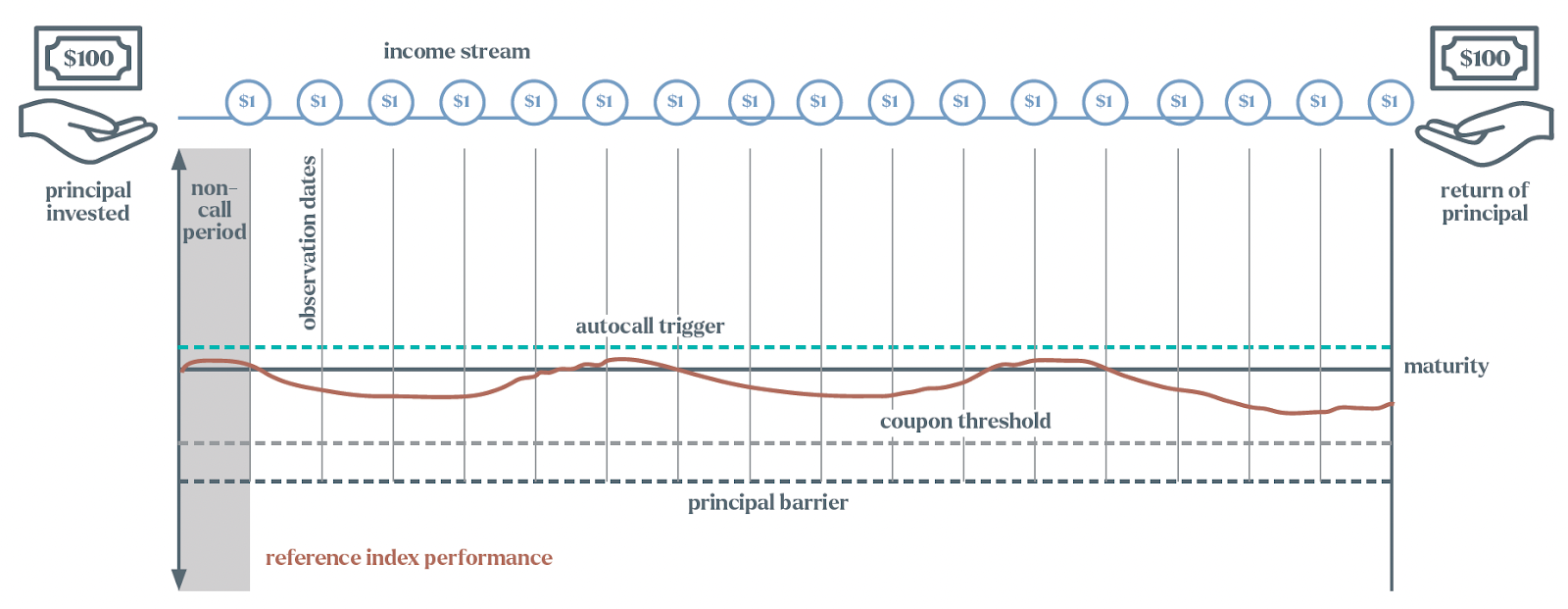
- Non-call Period: Autocallables typically have a non-call period at the beginning of the term during which the autocallable cannot be called early. This ensures the investor has a chance for income.
- Observation Dates: Monthly dates when the reference index performance is checked against the predesignated thresholds to determine what happens with the investment.
- Coupon Threshold: The pre-set level which the reference index must stay above on observation dates in order for income to be paid.
- Coupon: On monthly observation dates, the coupon (fixed income) is paid, assuming the reference index is above the pre-set coupon threshold.
- Maturity Date: The date when the investor receives their principal back, assuming the autocallable was not redeemed early.
- Principal Barrier: This is the level the reference index needs to be above on the maturity date in order to return your principal back in full.
- Autocall Trigger: If the index rises to or above the specific autocall level on a monthly observation date, you get your principal back early.
The autocallable is designed to pay a fixed income stream until maturity. This income payment is paid on “observation dates,” but only if the reference index (e.g., S&P 500) stays above a pre-set level, known as the coupon threshold. As long as the reference index stays above the coupon threshold, even if that means the reference index is down, coupons continue to be paid. If at maturity, the reference index is above the principal barrier, the investor’s principal is returned, even if the market has declined overall. If at any of the monthly observation dates the reference index is at or above the specific autocall trigger, the autocallable is redeemed and the investor gets their principal back early.
Historically, autocallables were complex products with high minimums and poor liquidity, available only to institutional and high net-worth investors. Autocallables in an ETF wrapper represent a market opportunity with the potential to smooth cash flow, lower concentration risk, and provide more predictable, high-yield income — helping investors maintain their lifestyle and portfolio stability even when markets are volatile.
TrueShares offers two new autocallable ETFs, the S&P Autocallable High Income ETF (PAYH) and the S&P Autocallable Defensive Income ETF (PAYM). PAYH and PAYM bring the popular autocallable income strategy to investors seeking high, stable income with monthly coupon payments. The ETF wrapper seeks to offer predictable income, contingent protection, and built-in hedging, all in a tax efficient single-ticker solution.
To learn more about the funds, visit: https://www.true-shares.com/autocallable-income-etfs
---


Thought Leadership,
Straight to Your Inbox
Disclosures
©2026, TrueShares, ©2026 TrueMark Investments, LLC. (“TrueMark”).
Before investing, carefully consider the TrueShares ETFs investment objectives, risks, charges and expenses. Specific information about TrueShares is contained in the prospectus and a summary prospectus, copies of which may be obtained by visiting www.www.true-shares.com. Read the prospectus carefully before you invest.
An investment in TrueShares is subject to numerous risks, including possible loss of principal. The ETFs are subject to the following principal risks: Authorized Participants, Market Makers, and Liquidity Providers Concentration Risk associated with ETFs; Equity Market Risk; Management Risk; Market Capitalization Risk (Large Cap; Mid Cap, Small Cap Stock); Market Risk; New Fund Risk: The Fund is a recently organized, non-diversified management investment company with no operating history. As a result, prospective investors have no track record or history on which to base their investment decision. Additionally, the Adviser has not previously managed a registered fund, which may increase the risks of investing in the Fund.
Depositary Receipts Risk. American Depositary Receipts (“ADRs”) have risks similar to those of foreign securities (political and economic conditions, changes in the exchange rates, etc.) and entitle the holder to all dividends and capital gains that are paid out on the underlying foreign shares.
Individual investors should contact their financial advisor or broker dealer representative for more information on TrueShares ETFs.
Investment Products and Services are: NOT FDIC INSURED / MAY LOSE VALUE / NO BANK GUARANTEE.
All registered investment companies, including TrueShares, are obliged to distribute portfolio gains to shareholders at year-end regardless of performance. Trading in TrueShares ETFs will also generate tax consequences and transaction expenses. The information provided is not intended to be tax advice. Tax consequences of dividend distributions may vary by individual taxpayer.
TrueShares ETFs are bought and sold through exchange trading at market price, not Net Asset Value (NAV), and are not individually redeemed from the fund. Shares may trade at a premium or discount to their NAV in the secondary market. Brokerage commissions will reduce returns.
ETF shares may be bought or sold throughout the day at their market price, not their NAV, on the exchange on which they are listed. Shares of ETFs are tradable on secondary markets and may trade either at a premium or a discount to their NAV on the secondary market. ETFs trade like stocks, fluctuate in market value and may trade at prices above or below the ETF’s NAV. Brokerage commissions and ETF expenses will reduce returns.
Fund Intelligence Mutual Fund Industry and ETF Award shortlists and winners are comprised of individuals and firms who have submitted entries or been nominated via the online submission process, as well as through recommendations from leading market participants. Fund Intelligence Mutual Fund Industry and ETF Award judges will use the submitted application material, as well as any uploaded supplemental information, to determine which firm, individual or product they believe to be the most suitable and deserving winners for each category. Fund Intelligence Mutual Fund Industry and ETF Award judges have the discretionary power to move nominations into alternative categories that they think may be more suitable. Fund Intelligence Mutual Fund Industry and ETF Awards were decided by an independent panel of 20 judges with expertise across the asset management space.
TrueShares ETFs (the “Funds”) are registered with the United States Securities and Exchange Commission under the Investment Company Act of 1940. The fund is distributed by Paralel Distributors LLC, Member FINRA. Paralel is not affiliated with TrueMark Investments, LLC. TrueMark Investments, LLC, is the investment advisor to the Funds and receives a fee from the Funds for its services.
TrueMark Investments, LLC is the investment advisor to the Funds and receives a fee from the Funds for its services.
TrueShares ETFs are offered only to United States residents, and information on this site is intended only for such persons. Nothing on this website should be considered a solicitation to buy nor an offer to sell shares of any fund in any jurisdiction where the offer or solicitation would be unlawful under the securities laws of such jurisdiction.