
Insights
Find the latest news and insights from TrueShares below.
How to Navigate a Downturn

By the end of the trading day on Monday, August 51, the Dow Jones had fallen -2.6%, the S&P 500 dropped -3%, and the NASDAQ fell -3.4%. The S&P 500 hadn’t seen a drop so severe in almost two years. All three market indices stayed low for a few days, but fully rebounded within a two-week period.
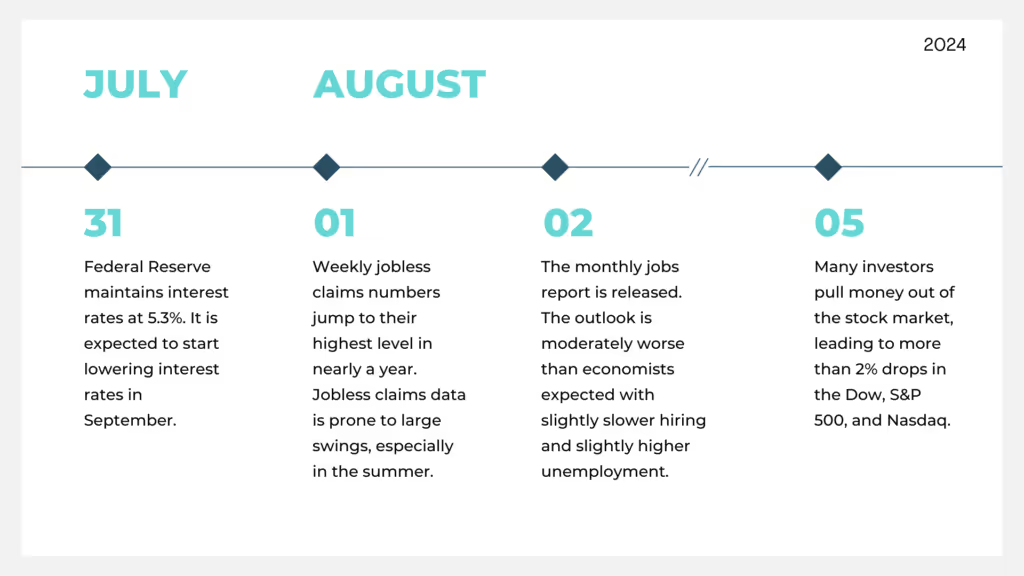
While what happened in early August2 was big, it wasn’t all that rare. The average year since 1980 has had 64 days3 with market moves that exceed 1%. Halfway through this year, there had only been 10. Though future downturns are inevitable, there are strategies for navigating a bear market with less risk.
#1 - Stay Invested
The selloffs that took place on August 5 were classic knee-jerk reactions that snowballed throughout the market. Selling begets more selling. The most important thing to do in a downturn is… nothing. Don’t sell. Stay invested.
Staying invested in a downturn is a generally sound policy because most of the market’s worst days3 over the past 20 years were followed by just as many of its best days. Over the last five years (as of August, 7 2024), the Invesco QQQ Trust (QQQ), an ETF based on the Nasdaq 100 index, has had 35 sessions that have lost at least 3%3. Yet over those same five years, QQQ was up 135%. Downturns happen, but so do rebounds.
It takes a lot of luck and know-how to return to the market right before the comeback and no one gets it right every time. Staying invested is one way to recover by capturing that upside rebound.
#2 - Hedging
Investors can do more than just stay invested and hope the ups outweigh the downs: they can add a hedging strategy to their portfolios.
Contrary to the types of hedge funds that operate within a high-risk-high-reward strategy, two new TrueShares hedge ETFs aim for principal protection in a downturn, reduced portfolio volatility, and even the potential for gains in a downturn.
These two hedge ETFs can be used individually or in tandem to navigate both bull (QBUL) and bear (QBER) market conditions with consistency. When added as accessories to an existing portfolio, QBUL/QBER can offer risk-averse investors unique equity gains potential in high-volatility environments.
They each seek to achieve their goals by emphasizing principal protection in the form of treasury bills* with modest equity exposure via call† or put†† options. In a falling stock market like we saw in early August, the risk of loss for QBER is limited to the cost of the put option if not surpassed by the market’s decline.
However, if the value of the large cap equity market surpasses the put option’s strike price‡, the option finishes in-the-money§ and may generate a positive total return. QBUL and QBER thereby seek to capture 20-40% of large-cap equity market swings in both directions, reducing portfolio volatility in the process.
In the midst of the early August meltdown, the Your Money columnist for the New York Times4 advised readers to “Go fly a kite or wander among beautiful buildings and check in with the market again tomorrow.”
We recommend considering QBUL/QBER for your portfolio and leaving the markets to us.
- https://www.barrons.com/livecoverage/stock-market-today-080524
- https://www.nytimes.com/2024/08/06/podcasts/the-daily/global-stock-market-fears.html
- https://www.etf.com/sections/advisor-center/financial-advisors-try-project-calm-during-market-plunges
- https://www.nytimes.com/2024/08/05/business/stock-market-advice.html
*Treasury bills: a short-dated government security, yielding no interest but issued at a discount on its redemption price.
†Call option: an option to buy assets at an agreed price on or before a particular date.
††Put option: an option to sell assets at an agreed price on or before a particular date.
‡Strike price: the price at which a put or call option can be exercised.
§In-the-money: the option presents a profit opportunity whereby the option holder can buy the security below (call) or sell the security above (put) its current market price.
The TrueShares Quarterly Bull Hedge ETF and TrueShares Quarterly Bear ETF are also subject to the following risks:
- Options Risk. Buying and selling (writing) options are speculative activities and entail greater investment risks. As the buyer of a call option, the Funds risk losing the entire premium invested in the option if the Funds do not exercise the option.
- Derivatives Risk. Derivatives may be more sensitive to changes in economic or market conditions than other types of investments.
- Active Management Risk. The adviser’s judgments about an investment may prove to be incorrect or fail to have the intended results, which could adversely impact the Fund’s performance. QBUL - The adviser’s tail risk strategy may not fully protect the Fund from declines in the market and will not allow the Fund to fully participate in market upside. When the adviser selects out-of-the money call options, the Fund will not participate in equity market gains until they exceed the strike price of the call option. Lower interest rates or higher call option prices will tend to increase the cost of mitigating the risk posed by a decline in U.S. large capitalization equity markets. QBER - The adviser’s tail risk strategy is not designed for upside participation in the markets and will underperform in rising equity markets relative to traditional long-only equity strategies. While the adviser’s strategy is designed to benefit from meaningful declines in the domestic large cap equity market, the Fund will not fully benefit from any given downswing in the market. When the adviser selects out-of-the money put options, the Fund will not participate in equity market declines until they exceed the strike price of the put option. Lower interest rates or higher put option prices will tend to increase the cost of attempting to benefit from meaningful declines in the U.S. large capitalization equity markets.
- Equity Market Risk. Common stocks are susceptible to general stock market fluctuations and to volatile increases and decreases in value as market confidence in and perceptions of their issuers change based on various and unpredictable factors including but not limited to expectations regarding government, economic, monetary and fiscal policies; inflation and interest rates; economic expansion or contraction; and global or regional political, economic and banking crises.
- Fixed Income Securities Risk. When the Fund invests in fixed income securities, the value of your investment in the Fund will fluctuate with changes in interest rates. Typically, a rise in interest rates causes a decline in the value of fixed income securities owned by the Fund. In general, the market price of fixed income securities with longer maturities will increase or decrease more in response to changes in interest rates than shorter-term securities.
- FLEX Options Risk. The Fund may invest in FLEX Options issued and guaranteed for settlement by the OCC. The Fund bears the risk that the OCC will be unable or unwilling to perform its obligations under the FLEX Options contracts. Additionally, FLEX Options may become illiquid, and in such cases, the Fund may have difficulty closing out certain FLEX Options positionsat desired times and prices.
NOT FDIC INSURED — NO BANK GUARANTEE — MAY LOSE VALUE
The funds are new with limited operating history.


.jpg)
Thought Leadership,
Straight to Your Inbox
Disclosures
©2026, TrueShares, ©2026 TrueMark Investments, LLC. (“TrueMark”).
Before investing, carefully consider the TrueShares ETFs investment objectives, risks, charges and expenses. Specific information about TrueShares is contained in the prospectus and a summary prospectus, copies of which may be obtained by visiting www.www.true-shares.com. Read the prospectus carefully before you invest.
An investment in TrueShares is subject to numerous risks, including possible loss of principal. The ETFs are subject to the following principal risks: Authorized Participants, Market Makers, and Liquidity Providers Concentration Risk associated with ETFs; Equity Market Risk; Management Risk; Market Capitalization Risk (Large Cap; Mid Cap, Small Cap Stock); Market Risk; New Fund Risk: The Fund is a recently organized, non-diversified management investment company with no operating history. As a result, prospective investors have no track record or history on which to base their investment decision. Additionally, the Adviser has not previously managed a registered fund, which may increase the risks of investing in the Fund.
Depositary Receipts Risk. American Depositary Receipts (“ADRs”) have risks similar to those of foreign securities (political and economic conditions, changes in the exchange rates, etc.) and entitle the holder to all dividends and capital gains that are paid out on the underlying foreign shares.
Individual investors should contact their financial advisor or broker dealer representative for more information on TrueShares ETFs.
Investment Products and Services are: NOT FDIC INSURED / MAY LOSE VALUE / NO BANK GUARANTEE.
All registered investment companies, including TrueShares, are obliged to distribute portfolio gains to shareholders at year-end regardless of performance. Trading in TrueShares ETFs will also generate tax consequences and transaction expenses. The information provided is not intended to be tax advice. Tax consequences of dividend distributions may vary by individual taxpayer.
TrueShares ETFs are bought and sold through exchange trading at market price, not Net Asset Value (NAV), and are not individually redeemed from the fund. Shares may trade at a premium or discount to their NAV in the secondary market. Brokerage commissions will reduce returns.
ETF shares may be bought or sold throughout the day at their market price, not their NAV, on the exchange on which they are listed. Shares of ETFs are tradable on secondary markets and may trade either at a premium or a discount to their NAV on the secondary market. ETFs trade like stocks, fluctuate in market value and may trade at prices above or below the ETF’s NAV. Brokerage commissions and ETF expenses will reduce returns.
Fund Intelligence Mutual Fund Industry and ETF Award shortlists and winners are comprised of individuals and firms who have submitted entries or been nominated via the online submission process, as well as through recommendations from leading market participants. Fund Intelligence Mutual Fund Industry and ETF Award judges will use the submitted application material, as well as any uploaded supplemental information, to determine which firm, individual or product they believe to be the most suitable and deserving winners for each category. Fund Intelligence Mutual Fund Industry and ETF Award judges have the discretionary power to move nominations into alternative categories that they think may be more suitable. Fund Intelligence Mutual Fund Industry and ETF Awards were decided by an independent panel of 20 judges with expertise across the asset management space.
TrueShares ETFs (the “Funds”) are registered with the United States Securities and Exchange Commission under the Investment Company Act of 1940. The fund is distributed by Paralel Distributors LLC, Member FINRA. Paralel is not affiliated with TrueMark Investments, LLC. TrueMark Investments, LLC, is the investment advisor to the Funds and receives a fee from the Funds for its services.
TrueMark Investments, LLC is the investment advisor to the Funds and receives a fee from the Funds for its services.
TrueShares ETFs are offered only to United States residents, and information on this site is intended only for such persons. Nothing on this website should be considered a solicitation to buy nor an offer to sell shares of any fund in any jurisdiction where the offer or solicitation would be unlawful under the securities laws of such jurisdiction.