
Insights
Find the latest news and insights from TrueShares below.
An Investor's Guide to the Green Arms Race
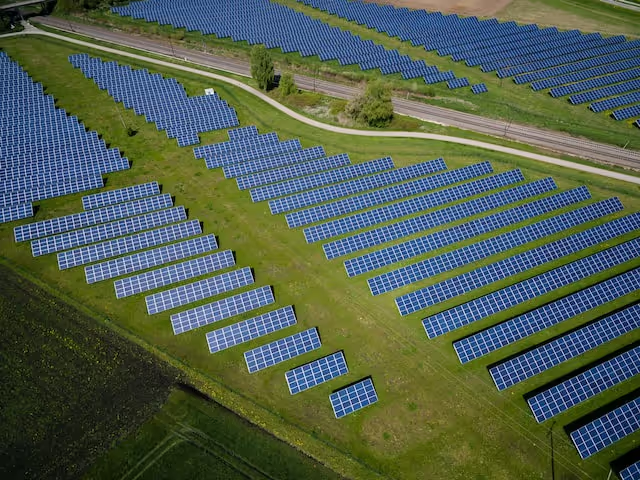
arms race (/ˈärmz ˌrās/): a competition between nations for superiority in the development and accumulation of weapons or renewable energy.
We confess to adding “renewable energy” into the definition. We also admit we’re surprised with the swift European response to the US Inflation Reduction Act (IRA) that has quickly escalated into a global race to attract renewables investment. The basic gist of the “green arms race” is that governments across the globe are competing to see who can attract the most investment in renewable energy to their country and away from others.
This trend of public policy support is not new, but what is new is the size and scope of government support, and the attitude of “Anything you can do I can do better!” The atmosphere is similar to the attitude taken during the nuclear arms race, where the United States and the Soviet Union competed to see who could develop the most destructive military weaponry. “Green arms race” captures the recent trend of governments utilizing public policy in a huge way to promote and advance energy transition. It’s also nice to know that the goal is a cleaner and greener earth, not nuclear annihilation. There are worse things governments could be spending taxpayer dollars on!
Game On! How The Inflation Reduction Act Mic Drop Accelerated The “Green Arms Race”
The passage of the Inflation Reduction Act (IRA) in August 2022 came as a surprise to many, given its proximity to the midterm elections, inflationary pressures, and of course the Russia-Ukraine conflict that was dominating headlines. This was a big, game-changing piece of legislation that impacts many industries that play a role in energy transition. An analysis from Bloomberg New Energy Finance shows investment in energy transition will need to more than double from 2022 levels to $4.6 trillion annually through 2030 and more so after that to achieve net zero by 2050.

Source: Bloomberg New Energy Finance
So this investment is what companies are playing for. IRA is a magnet that attracts capital to the United States, and while government leaders may believe capital is infinite - that is not the case for businesses. For them, the decision will always be where and how to invest for the highest return. Post-IRA, the United States went from being a country with modest return expectations to a country with expectations for something much higher. What’s wrong with this? In the eyes of some, every dollar spent in the United States is one less dollar spent elsewhere. Namely, Europe. It’s widely known that the European Union has been leading energy transition, and they had every intention of continuing this leadership position following the breakout of Russia-Ukraine hostilities. So for them, the problem is clear. Every dollar invested in the United States is one less dollar invested in Europe, and that means a response is necessary. In early February, the European Union leaked and then officially proposed the “Green Deal Industrial Plan”, or GDIP. While still conceptual, early indications are that the incentives package will somewhat match the size of IRA, if not the scope. The motivation is also in plain sight as European leaders emphasize that GDIP is a direct response to IRA, with the goal that utilizing public policy will attract capital back to Europe. Game on!
Why The “Green Arms Race” Matters To Your Portfolio
There is a saying on Wall Street (and in sports) that investors should go to where the puck is going, not where it’s been. Initiatives like the Inflation Reduction Act and the Green Deal Industrial Plan are backstopping what can likely be the largest capital investment the world has ever seen. Within this spending, a majority will be on renewable energy infrastructure itself - like solar fields, wind farms, geothermal, biomass, and more. Of the $4.5 trillion that BNEF estimates will be spent annually through 2030, a significant chunk falls into this asset class. So the question then becomes how do you as an investor take advantage of the paradigm shift that is energy transition. In its most basic form, we believe investors have two options: invest in manufacturers/innovators or invest in the owner/operators of the assets themselves. There is no wrong answer as it comes down to each investor’s risk appetite. However, as long-time investors, we prefer the income oriented, risk-adjusted return profile of owning the long-term cash flow streams that asset owners enjoy. We also very much like that renewable energy infrastructure is tied in with the energy transition megatrend.
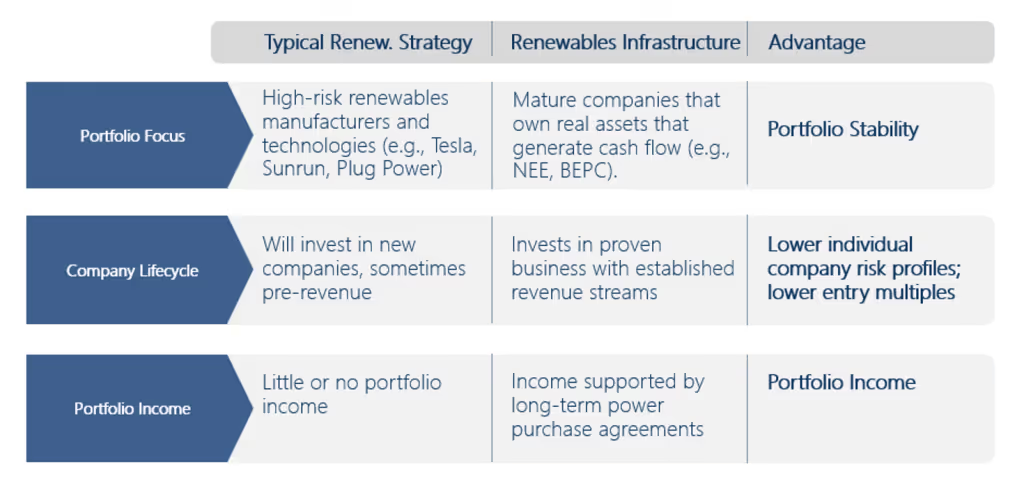
Finally, we believe that while the rising tide lifts all boats when it comes to energy transition, for some companies the tide may rise higher than others. There is meaningful alpha to be had as companies are competing from different places. Some will adapt, and some will wither. After all, there are stark differences in cost of capital, balance sheet strength, access to the supply chain, and most importantly, human capital to name just a few. Therefore, we believe the range of outcomes is fairly wide and that makes the sector ripe for active management. We’ll leave that for another note or perhaps a conversation. Until then know the “green arms race” is real and is happening, and your investments should start to reflect it.


Thought Leadership,
Straight to Your Inbox
Disclosures
©2026, TrueShares, ©2026 TrueMark Investments, LLC. (“TrueMark”).
Before investing, carefully consider the TrueShares ETFs investment objectives, risks, charges and expenses. Specific information about TrueShares is contained in the prospectus and a summary prospectus, copies of which may be obtained by visiting www.www.true-shares.com. Read the prospectus carefully before you invest.
An investment in TrueShares is subject to numerous risks, including possible loss of principal. The ETFs are subject to the following principal risks: Authorized Participants, Market Makers, and Liquidity Providers Concentration Risk associated with ETFs; Equity Market Risk; Management Risk; Market Capitalization Risk (Large Cap; Mid Cap, Small Cap Stock); Market Risk; New Fund Risk: The Fund is a recently organized, non-diversified management investment company with no operating history. As a result, prospective investors have no track record or history on which to base their investment decision. Additionally, the Adviser has not previously managed a registered fund, which may increase the risks of investing in the Fund.
Depositary Receipts Risk. American Depositary Receipts (“ADRs”) have risks similar to those of foreign securities (political and economic conditions, changes in the exchange rates, etc.) and entitle the holder to all dividends and capital gains that are paid out on the underlying foreign shares.
Individual investors should contact their financial advisor or broker dealer representative for more information on TrueShares ETFs.
Investment Products and Services are: NOT FDIC INSURED / MAY LOSE VALUE / NO BANK GUARANTEE.
All registered investment companies, including TrueShares, are obliged to distribute portfolio gains to shareholders at year-end regardless of performance. Trading in TrueShares ETFs will also generate tax consequences and transaction expenses. The information provided is not intended to be tax advice. Tax consequences of dividend distributions may vary by individual taxpayer.
TrueShares ETFs are bought and sold through exchange trading at market price, not Net Asset Value (NAV), and are not individually redeemed from the fund. Shares may trade at a premium or discount to their NAV in the secondary market. Brokerage commissions will reduce returns.
ETF shares may be bought or sold throughout the day at their market price, not their NAV, on the exchange on which they are listed. Shares of ETFs are tradable on secondary markets and may trade either at a premium or a discount to their NAV on the secondary market. ETFs trade like stocks, fluctuate in market value and may trade at prices above or below the ETF’s NAV. Brokerage commissions and ETF expenses will reduce returns.
Fund Intelligence Mutual Fund Industry and ETF Award shortlists and winners are comprised of individuals and firms who have submitted entries or been nominated via the online submission process, as well as through recommendations from leading market participants. Fund Intelligence Mutual Fund Industry and ETF Award judges will use the submitted application material, as well as any uploaded supplemental information, to determine which firm, individual or product they believe to be the most suitable and deserving winners for each category. Fund Intelligence Mutual Fund Industry and ETF Award judges have the discretionary power to move nominations into alternative categories that they think may be more suitable. Fund Intelligence Mutual Fund Industry and ETF Awards were decided by an independent panel of 20 judges with expertise across the asset management space.
TrueShares ETFs (the “Funds”) are registered with the United States Securities and Exchange Commission under the Investment Company Act of 1940. The fund is distributed by Paralel Distributors LLC, Member FINRA. Paralel is not affiliated with TrueMark Investments, LLC. TrueMark Investments, LLC, is the investment advisor to the Funds and receives a fee from the Funds for its services.
TrueMark Investments, LLC is the investment advisor to the Funds and receives a fee from the Funds for its services.
TrueShares ETFs are offered only to United States residents, and information on this site is intended only for such persons. Nothing on this website should be considered a solicitation to buy nor an offer to sell shares of any fund in any jurisdiction where the offer or solicitation would be unlawful under the securities laws of such jurisdiction.