
Insights
Find the latest news and insights from TrueShares below.
Redefining Outcomes

The market continues to confound investors, with the S&P 500 YTD total returns of approximately 19%[1], dramatically ahead of Wall Street’s full year estimates for 2023. Many are bracing for another meaningful selloff, while others are positioned as long as they have been in years. Allocating client portfolios in the face of this unpredictability is a serious challenge, especially for those who came into the year underweight equities.
One prominent solution is to change the structure of client exposures through the use of options. The proliferation of buffered products shows how much demand clients have for adding a little risk management to their market risk. If the market is going to sell off by another 20% this year, potentially cutting that loss in half helps clients feel more confident and reduces the risk of them making catastrophic decisions like selling at the lows.
Asset flows into products with buffers have grown dramatically since the onset of the global pandemic, though largely in a format that limits upside potential. While buffers utilize put options to insure against certain levels of loss, call options are often used to generate the cash needed to buy that insurance. Too much of the industry has decided to cap the upside potential of what are ostensibly equity-linked products, and this has led to severe underperformance of equity benchmarks. For example, in the year ending June 30, 2021, the S&P 500 rallied by over 40%[2], while capped products underperformed by as much as 25 percentage points. Assuming an average annual S&P 500 total return of 9.6% implies a 2.4 year hole that has just been dug, with little chance of escape[3].
Instead of capping the upside of equity returns, another approach is a partial reduction in upside participation, without a hard limit. Altering the call positioning, specifically by removing the “cap”, will allow an investor to participate in the majority of the upside of stocks, with no limit, although only at a rate of 75-80% of the increase in prices. We feel these “uncapped buffer” products are a smarter way to allocate to equities as the potential for significant moves in either direction looms.
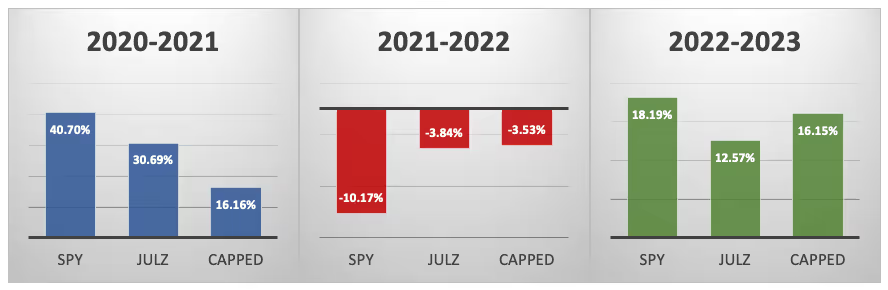
Source: Bloomberg
[1] Bloomberg SPXT INDEX as of 7/17/2023
[2] Bloomberg SPXT INDEX from 6/30/2020 - 6/30/2021
[3] Simple geometric return calculation solving for periods – implies needing an annualized 9.6% outperformance vs SPXT to break even (SPXT INDEX average yearly returns from 12/31/1992 - 12/30/2022)
An ETF wrapper may be the best solution, as capital gains can largely be deferred (allowing for further compounding of returns), and investors can avoid the burden of option paperwork at their custodians. Low investment minimums, daily liquidity, and the ability to buy into the market systematically over time are also benefits of this structure. The uncapped nature will benefit any investor looking to incorporate the “buffer” into their core equity allocation, as the ability to track the S&P more closely in all environments is proving to be a beneficial attribute.
With market prognosticators rushing to pump up their year-end estimates in light of the incredible first half of 2023, the potential for both continued upside or a market selloff exists. Adding a buffered and uncapped exposure to client assets could result in significant savings should a selloff occur while also providing the ability to participate in the market should we return to previous highs. Positioning clients in these products should serve investors well regardless of which direction Mr. Market chooses.
Call Options: Call options are financial contracts that give the option buyer the right but not the obligation to buy a stock, bond, commodity, or other asset or instrument at a specified price within a specific time period. The stock, bond, or commodity is called the underlying asset. A call buyer profits when the underlying asset increases in price.
Put Options: A put option (or “put”) is a contract giving the option buyer the right, but not the obligation, to sell—or sell short—a specified amount of an underlying security at a predetermined price within a specified time frame. This predetermined price at which the buyer of the put option can sell the underlying security is called the strike price.
Structured Outcome ETFs have characteristics unlike many other traditional investment products and may not be suitable for all investors. You should only consider an investment in the Fund if you fully understand the inherent risks, which can be found in the prospectus.
The Funds invest in options, which involves leverage, meaning that a small investment in options could have a substantial impact on the performance of the Fund. There can be no guarantee that a Fund will achieve its investment objective.



Thought Leadership,
Straight to Your Inbox
Disclosures
©2026, TrueShares, ©2026 TrueMark Investments, LLC. (“TrueMark”).
Before investing, carefully consider the TrueShares ETFs investment objectives, risks, charges and expenses. Specific information about TrueShares is contained in the prospectus and a summary prospectus, copies of which may be obtained by visiting www.www.true-shares.com. Read the prospectus carefully before you invest.
An investment in TrueShares is subject to numerous risks, including possible loss of principal. The ETFs are subject to the following principal risks: Authorized Participants, Market Makers, and Liquidity Providers Concentration Risk associated with ETFs; Equity Market Risk; Management Risk; Market Capitalization Risk (Large Cap; Mid Cap, Small Cap Stock); Market Risk; New Fund Risk: The Fund is a recently organized, non-diversified management investment company with no operating history. As a result, prospective investors have no track record or history on which to base their investment decision. Additionally, the Adviser has not previously managed a registered fund, which may increase the risks of investing in the Fund.
Depositary Receipts Risk. American Depositary Receipts (“ADRs”) have risks similar to those of foreign securities (political and economic conditions, changes in the exchange rates, etc.) and entitle the holder to all dividends and capital gains that are paid out on the underlying foreign shares.
Individual investors should contact their financial advisor or broker dealer representative for more information on TrueShares ETFs.
Investment Products and Services are: NOT FDIC INSURED / MAY LOSE VALUE / NO BANK GUARANTEE.
All registered investment companies, including TrueShares, are obliged to distribute portfolio gains to shareholders at year-end regardless of performance. Trading in TrueShares ETFs will also generate tax consequences and transaction expenses. The information provided is not intended to be tax advice. Tax consequences of dividend distributions may vary by individual taxpayer.
TrueShares ETFs are bought and sold through exchange trading at market price, not Net Asset Value (NAV), and are not individually redeemed from the fund. Shares may trade at a premium or discount to their NAV in the secondary market. Brokerage commissions will reduce returns.
ETF shares may be bought or sold throughout the day at their market price, not their NAV, on the exchange on which they are listed. Shares of ETFs are tradable on secondary markets and may trade either at a premium or a discount to their NAV on the secondary market. ETFs trade like stocks, fluctuate in market value and may trade at prices above or below the ETF’s NAV. Brokerage commissions and ETF expenses will reduce returns.
Fund Intelligence Mutual Fund Industry and ETF Award shortlists and winners are comprised of individuals and firms who have submitted entries or been nominated via the online submission process, as well as through recommendations from leading market participants. Fund Intelligence Mutual Fund Industry and ETF Award judges will use the submitted application material, as well as any uploaded supplemental information, to determine which firm, individual or product they believe to be the most suitable and deserving winners for each category. Fund Intelligence Mutual Fund Industry and ETF Award judges have the discretionary power to move nominations into alternative categories that they think may be more suitable. Fund Intelligence Mutual Fund Industry and ETF Awards were decided by an independent panel of 20 judges with expertise across the asset management space.
TrueShares ETFs (the “Funds”) are registered with the United States Securities and Exchange Commission under the Investment Company Act of 1940. The fund is distributed by Paralel Distributors LLC, Member FINRA. Paralel is not affiliated with TrueMark Investments, LLC. TrueMark Investments, LLC, is the investment advisor to the Funds and receives a fee from the Funds for its services.
TrueMark Investments, LLC is the investment advisor to the Funds and receives a fee from the Funds for its services.
TrueShares ETFs are offered only to United States residents, and information on this site is intended only for such persons. Nothing on this website should be considered a solicitation to buy nor an offer to sell shares of any fund in any jurisdiction where the offer or solicitation would be unlawful under the securities laws of such jurisdiction.