
Insights
Find the latest news and insights from TrueShares below.
ETFs vs. Mutual Funds

Much like a thoughtful gift, quality investment tools come in packages of all shapes and sizes. Two well-known investment packages are mutual funds and exchange-traded funds (ETFs), which might look the same from the wrapping, but have significant differences once we peek inside.
Mutual funds have been around since 1924 while ETFs are a relatively newer addition to the markets, having landed on the scene in 1993. Mutual funds outnumber ETFs, but the number of mutual funds has been declining for several years while ETFs have been increasing since their inception.
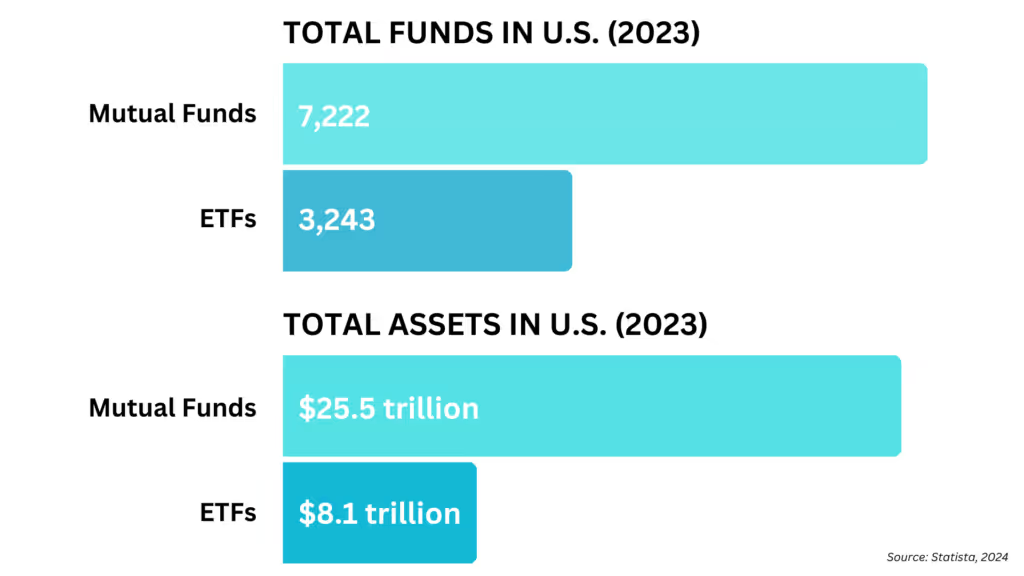
Both types of funds are designed to package groups of assets toward an overall investment goal. Both can invest in stocks, bonds, and other types of securities. The similarities more or less end there.
First, ETFs are (usually) more tax-efficient than mutual funds. Mutual funds pool money from investors to purchase stocks, bonds, and other securities. Therefore, every time a shareholder adds new money to a mutual fund or redeems their shares, the underlying securities must be bought or sold, respectively. Taxable events in the form of capital gains accumulate throughout the year and all investors incur the cost, regardless of fund performance.
ETFs, on the other hand, minimize taxable events by exchanging ETF shares and underlying securities “in-kind” whenever possible, making capital gains distributions less likely. An ETF investor’s capital gains are not influenced by other investors entering and exiting the fund.
ETFs also tend to have lower fees than mutual funds because ETFs are typically passively managed while mutual funds are actively managed. However, fees may vary as some ETFs, like most of those offered by TrueMark Investments, are actively managed by experienced portfolio managers. ETFs may also incur additional costs associated with buying and selling, such as brokerage commissions. Brokerage commissions and other ETF expense reduce overall return.
Here are some other key differences between ETFs and mutual funds:
- ETFs can be bought and sold whenever the market is open. Mutual funds can only be bought and sold at the end of the trading day.
- Most ETFs publish their holdings daily, offering more transparency than a mutual fund.
- Unlike mutual funds, ETFs are listed on an exchange and are traded like a stock.
- ETFs buy and sell the holdings in their package less often than a mutual fund.
- Mutual funds tend to have higher minimum investment requirements than ETFs. The minimum investment requirement for a mutual fund is often a flat amount whereas the minimum investment requirement for an ETF is typically the price of one share.
- ETF shares can be bought and sold on the open market between investors. Mutual fund shares can only be traded with the fund provider.
In summary, investors tend to choose ETFs over mutual funds for their tax efficiency, lower fees, flexibility, and transparency. While every fund is its own unique package, the best way to pick the right one is to take a peek inside.
Source: www.investopedia.com/articles/exchangetradedfunds/08/etf-mutual-fund-difference.asp


Thought Leadership,
Straight to Your Inbox
Disclosures
©2026, TrueShares, ©2026 TrueMark Investments, LLC. (“TrueMark”).
Before investing, carefully consider the TrueShares ETFs investment objectives, risks, charges and expenses. Specific information about TrueShares is contained in the prospectus and a summary prospectus, copies of which may be obtained by visiting www.www.true-shares.com. Read the prospectus carefully before you invest.
An investment in TrueShares is subject to numerous risks, including possible loss of principal. The ETFs are subject to the following principal risks: Authorized Participants, Market Makers, and Liquidity Providers Concentration Risk associated with ETFs; Equity Market Risk; Management Risk; Market Capitalization Risk (Large Cap; Mid Cap, Small Cap Stock); Market Risk; New Fund Risk: The Fund is a recently organized, non-diversified management investment company with no operating history. As a result, prospective investors have no track record or history on which to base their investment decision. Additionally, the Adviser has not previously managed a registered fund, which may increase the risks of investing in the Fund.
Depositary Receipts Risk. American Depositary Receipts (“ADRs”) have risks similar to those of foreign securities (political and economic conditions, changes in the exchange rates, etc.) and entitle the holder to all dividends and capital gains that are paid out on the underlying foreign shares.
Individual investors should contact their financial advisor or broker dealer representative for more information on TrueShares ETFs.
Investment Products and Services are: NOT FDIC INSURED / MAY LOSE VALUE / NO BANK GUARANTEE.
All registered investment companies, including TrueShares, are obliged to distribute portfolio gains to shareholders at year-end regardless of performance. Trading in TrueShares ETFs will also generate tax consequences and transaction expenses. The information provided is not intended to be tax advice. Tax consequences of dividend distributions may vary by individual taxpayer.
TrueShares ETFs are bought and sold through exchange trading at market price, not Net Asset Value (NAV), and are not individually redeemed from the fund. Shares may trade at a premium or discount to their NAV in the secondary market. Brokerage commissions will reduce returns.
ETF shares may be bought or sold throughout the day at their market price, not their NAV, on the exchange on which they are listed. Shares of ETFs are tradable on secondary markets and may trade either at a premium or a discount to their NAV on the secondary market. ETFs trade like stocks, fluctuate in market value and may trade at prices above or below the ETF’s NAV. Brokerage commissions and ETF expenses will reduce returns.
Fund Intelligence Mutual Fund Industry and ETF Award shortlists and winners are comprised of individuals and firms who have submitted entries or been nominated via the online submission process, as well as through recommendations from leading market participants. Fund Intelligence Mutual Fund Industry and ETF Award judges will use the submitted application material, as well as any uploaded supplemental information, to determine which firm, individual or product they believe to be the most suitable and deserving winners for each category. Fund Intelligence Mutual Fund Industry and ETF Award judges have the discretionary power to move nominations into alternative categories that they think may be more suitable. Fund Intelligence Mutual Fund Industry and ETF Awards were decided by an independent panel of 20 judges with expertise across the asset management space.
TrueShares ETFs (the “Funds”) are registered with the United States Securities and Exchange Commission under the Investment Company Act of 1940. The fund is distributed by Paralel Distributors LLC, Member FINRA. Paralel is not affiliated with TrueMark Investments, LLC. TrueMark Investments, LLC, is the investment advisor to the Funds and receives a fee from the Funds for its services.
TrueMark Investments, LLC is the investment advisor to the Funds and receives a fee from the Funds for its services.
TrueShares ETFs are offered only to United States residents, and information on this site is intended only for such persons. Nothing on this website should be considered a solicitation to buy nor an offer to sell shares of any fund in any jurisdiction where the offer or solicitation would be unlawful under the securities laws of such jurisdiction.